



Most "fleet management software" was built for one of two worlds — long-haul trucking or service vehicles — and most vendors handle construction as an afterthought.
Construction is its own animal. Mixed assets (pickups, dump trucks, excavators, skid steers, crew vans). Multi-stop jobs run by 2–3 person crews, not single-driver routes. Billing tied to site arrival and on-site time. Equipment that doesn't have a CAN bus to plug telematics into. Customers who want a live ETA on the truck, not "we'll be there in the afternoon."
If your software doesn't get those four things right, you'll fight it for two years.
Quick disclosure. We make Fleet Chaser. Built for construction and construction-adjacent fleets — construction, roofing, landscaping, waste management, transportation and regional logistics. 10 to 300+ assets. $20–25 per vehicle per month, month-to-month, no contract, unlimited users.
Here's what to actually evaluate.
1. Dispatch built for crews and multi-stop jobs (not single-driver routes)
This is where most "fleet management software" breaks for construction. Their dispatch was built for over-the-road trucking — one driver, one truck, one route, one delivery. Construction reality: a 3-person crew, a pickup pulling a trailer, a job site with a load, a work stop, and a drop. The "dispatch" feature in most tools doesn't model any of that, so the job ends up living as an address typed into a task description and the driver figures it out.
What construction dispatch actually needs:
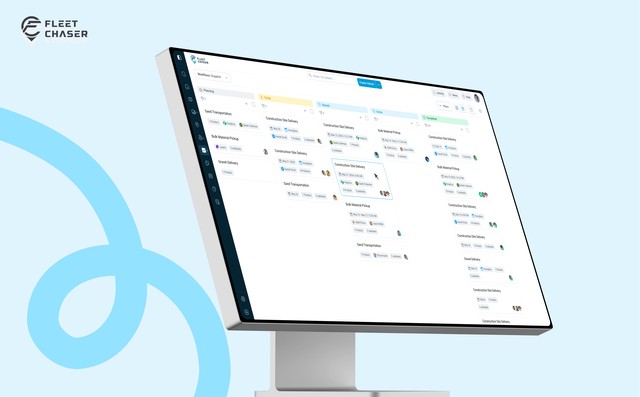
- Multi-assignee tasks. A site prep with 3 crew members on it isn't 3 separate tasks. It's one task with 3 people who see the same job on their phones, log against the same record, and finish together.
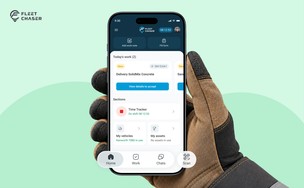
- Typed, gated route stops. Not just "addresses in order" — Load, Delivery, and Job Site as distinct stop types, color-coded on the map. And Job Site stops have to gate the route, so the driver can't tap through to the next leg without logging the work that was supposed to happen there.
- Drafts, scheduling, transfer. Build the task the night before (drafts). Auto-publish it to the crew on the morning of (schedule automation). Hand the job to a different team mid-day without re-typing the address, attachments, and route (transfer between teams).
- Progress visibility. The manager opens the task and sees exactly what was done, when, by whom — not "the crew said they're done."
How vendors handle it:
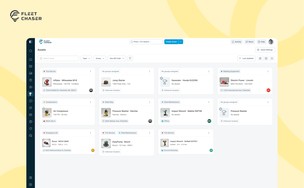
- Fleet Chaser — dispatch is the product we've been pushing hardest. Tasks support multi-assignee, drafts, scheduling, and team-to-team transfer. Routes use Load (blue), Delivery (green), and Job Site (orange) typed checkpoints; Job Sites gate the route so the driver can't advance until work is logged. Real ORM records, not text blobs — sequence, GPS, and per-stop logs hold up as jobs get complex. Progress view shows the manager what's done in real time.
- Samsara — strong on telematics. Dispatch is a more recent product layer, OTR-flavored; mixed-crew workflows are doable but not native.
- Fleetio — maintenance-first platform. Dispatch is the Workflows add-on, not the core product. Multi-assignee on a single task is limited.
- Motive — dispatch is built for OTR trucking single-driver routes. Heavy equipment plus crew workflow isn't really the product.
- Verizon Connect — enterprise telematics depth; dispatch UX dates back to the legacy stack and feels it.
- Tenna — strong on equipment tracking, lighter on day-to-day dispatch and crew workflow.
The vendor test: ask them to build a 3-stop task (load → work site → delivery) with a 2-person crew assigned, then play out what happens on the driver's phone when the crew arrives at the work site and hasn't logged work yet. Time how smooth the demo is.
2. Mixed-asset tracking in one dashboard
The second thing that separates construction-aware tools from everything else: does the same screen show your pickups and dump trucks AND your excavators, skid steers, dozers, and trailers — with the same metrics?
For a 25-truck operation with 15 pieces of heavy equipment, you have a 40-asset fleet. Most "fleet management software" gives you 25 of those well and 15 as an afterthought: no equipment-hour tracking, no PM schedules by engine hours instead of miles, telematics that won't connect to anything without a CAN bus.
What separation costs you in practice: two tools, two logins, two invoices, two help desks, two integrations into your billing system. Heavy equipment goes dark on the wrong dashboard until somebody notices a missed PM.
How vendors handle it:
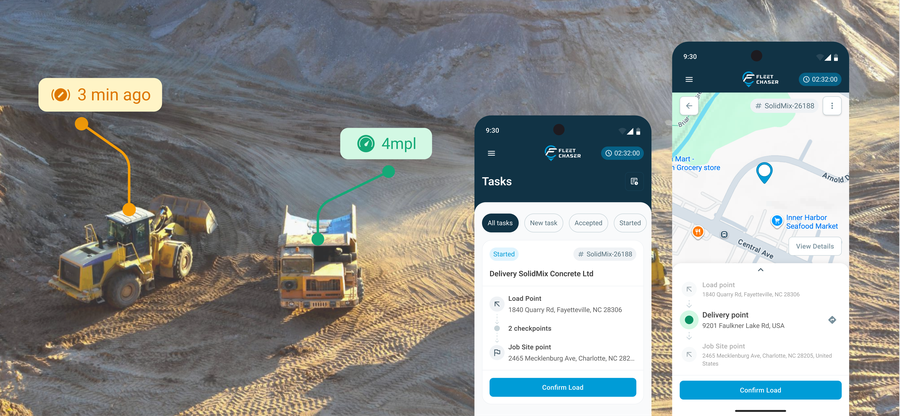
- Fleet Chaser — vehicles and equipment on the same Live Map, 99% compatibility across dozers, excavators, graders, pavers, trailers. Engine hours tracked the way truck miles are. GPS updates every 5 seconds, 5-meter accuracy.
- Samsara — world-class for trucks, dashcams excellent. Equipment is the secondary product; mid-market construction shops we talk to often end up running two tools.
- Fleetio — maintenance-first. Native GPS doesn't exist — they integrate with Samsara or Geotab. Equipment tracking is bottlenecked by whichever telematics provider you bolt on, plus a second invoice.
- Motive — built for over-the-road trucking. Heavy equipment isn't really the product.
- Tenna — the closest direct construction-mixed competitor. Strong on equipment tracking, lighter on the dispatch side.
- Linxup / GPS Trackit — GPS-only at a low price. Fine for "where is my truck right now". Not a fleet management system.
The vendor test: ask them to demo your fleet, not their demo fleet. Drop a skid steer on the map with engine hours and a PM schedule by hours. Watch what happens.
3. Geofences that turn into invoices
For construction, geofences aren't a feature — they're an invoice line. Site arrival, on-site time, departure. Three timestamps customers pay against without arguing.
It's not whether a tool has geofencing — they all claim to. It's whether the data flows somewhere useful.
The depth questions:
- Can you pull a per-customer, per-job arrival and duration report in 30 seconds without exporting CSVs?
- Can a geofence trigger an alert on a specific vehicle outside specific hours (the after-hours theft tripwire)?
- Can you draw a polygon (irregular shape) on an active job site, not just a circle around a fixed address?
- Does a geofence on a finished job auto-archive, or do you accumulate stale alerts everyone ignores by month three?
Most enterprise telematics platforms have geofencing as a feature flag — alerts work, the reporting is buried four menus deep, and nobody uses it after week three.
What Fleet Chaser built around it: polygon shapes for irregular job sites, per-vehicle or per-asset rules, time-windowed alerts (after-hours exits go to the fleet manager only), and customer-facing Live Share links — Uber-style trackable URLs you send the customer with an ETA, not "we'll be there in the afternoon." Customers stop calling for status.
This is where Landmark Materials — 30 trucks in Monroe, NC, five years on the platform — saved $100K+ in fraudulent accident claims (GPS plus in-cab dashcam evidence on every alleged incident), cut idle time 60%, and lifted fleet efficiency 40%. The GPS data isn't the feature. The fact that it shows up as defensible evidence in an insurance dispute is.
4. Pricing that matches how construction buys
Fleet software pricing falls into four tiers. Construction SMB sweet spot is one of them:
- Basic GPS-only — $5–15 per vehicle per month. Location only, no dispatch, no inspections, no maintenance module. Linxup, GPS Trackit, the cheaper telematics resellers.
- SMB construction-aware — $15–30 per vehicle per month. GPS plus geofences plus dispatch plus tasks plus inspections plus driver app plus maintenance. Fleet Chaser ($20–25/v/m), GPS Insight, ClearPathGPS, One Step GPS.
- Mid-market trucking-grade — $30–50 per vehicle per month. The above plus deep ELD/HOS, driver scorecards, integrations, dedicated CSM. Motive, Samsara starter, Verizon Connect mid-tier.
- Enterprise — $50+ per vehicle per month. The above plus advanced AI dashcam fleet, multi-region, SLA, 1–3 year contracts. Samsara, Geotab, Lytx, Verizon Connect enterprise.
The traps in this layer:
- "Starting at" pricing is for 100+ vehicles on annual prepay with no add-ons. The real price for a 25-vehicle month-to-month account is usually 1.5–2× the headline rate.
- Hardware fees stack separately. Most vendors lease GPS trackers at $5–10 per unit per month or sell them at $100–250 outright. Dashcams add $25+ per camera per month on top of the vehicle plan.
- Per-seat user pricing is a hidden tax. A 30-vehicle fleet can easily have 6 managers, 4 mechanics, and 1 safety officer logging in. Pick vendors that price by vehicle (Fleet Chaser, Samsara) not per user — otherwise role-based dashboards become an upsell instead of a feature.
- Multi-year discounts of 20–30% sound great until you want out in month 9. Sign annual on the first year with any vendor. Renew multi-year only after you've lived with the tool through one full season.
Fleet Chaser's specific pricing: $20–25 per vehicle per month, $25+ per dashcam per month, no contract minimum, unlimited users. This isn't us being virtuous — it's what construction SMBs actually need.
What this looks like in real numbers
Three customers, named, across three industries:
Home Evolution Roofing (Albany, NY) — roofing, 40+ trucks and vans. Switched from manual maintenance tracking. $60K+ saved annually, 3× faster maintenance scheduling, 20% faster on-site work. Quote from the maintenance manager: "Without Fleet Chaser, we'd need a full-time person just to track maintenance manually."
Landmark Materials (Monroe, NC) — construction, 30 trucks. Was getting hit by fraudulent accident claims at roughly $100K each. $100K+ saved on false claims (GPS plus dashcam evidence on every alleged incident), 60% reduction in idle time, 40% increase in fleet efficiency. Five years in.
Lake Norman Turf (NC) — landscaping. "The trackers paid for themselves in the first month from our savings."
Three different industries, three different fleet sizes, the same outcome: the tool paid for itself faster than the trial period.
Two questions to ask any fleet software vendor
Skip the feature checklist. Ask these on the demo call:
First, "Build me a 3-stop task — load, work site, delivery — with a 2-person crew assigned. Show me what happens on the driver's phone when the crew arrives at the work site and hasn't logged the work yet." What you're looking for: does the route stop the driver from advancing, with a clear "log the work first" UX? Or does the demo skim past that case? In the field, that one detail decides whether work actually gets logged at every site.
Second, "What's the cancellation clause? Walk me through what happens if I want to leave in month 9." Annual prepay with non-refundable terms is the SMB default trap. If they can't answer cleanly in 30 seconds, you're being set up for a 3-year contract you won't enjoy reading later.
We fit almost any construction-adjacent operation
If your business looks like one of these, Fleet Chaser is almost certainly a fit:
- Construction (primary focus) — general contractors, dump truck operators, paving, earthmoving, concrete, demolition
- Roofing
- Landscaping
- Waste management and hauling
- Transportation and regional logistics (not pure long-haul)
- Field service — HVAC, plumbing, electrical, anywhere crews go to job sites
We're not the right call in two genuine edge cases: a 500+ vehicle multi-region operation that needs deep custom telematics integrations (Geotab is the platform), or a pure long-haul trucking fleet where ELD/HOS is the central pain (Motive is purpose-built for that). For everything else in the construction-adjacent space, we built this specifically for you.
Try it
Book a demo at fleetchaser.com. Bring your asset mix, a customer site address, and the cancellation clause from your current vendor. We'll have your fleet on the map, a geofence drawn, and a 3-stop task with a 2-person crew running on a phone before the call ends. If we're not the right fit, we'll tell you which of the vendors above is.