


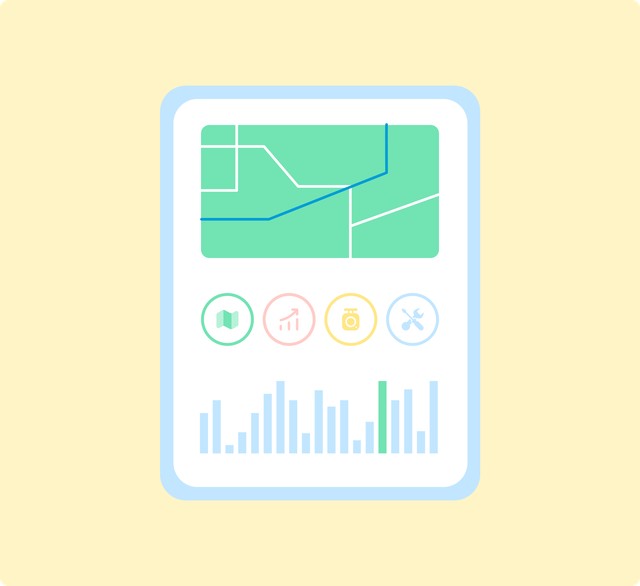

Construction fleets are a strange shape compared to what most "fleet management software" was built for. You're running mixed assets — pickups, dump trucks, excavators, skid steers, crew vans — across multi-stop jobs with 2–3 person crews, billing based on site arrival and on-site time, with equipment that doesn't have a CAN bus to plug telematics into.
Fleet management technology promises to bring all of that under one dashboard. The reality varies wildly between vendors: some platforms were built for over-the-road trucking and treat construction as an afterthought, others handle GPS well but miss the dispatch workflow that defines a construction day.
This guide is the construction-specific version of "what is fleet management technology." We make Fleet Chaser, built specifically for construction and construction-adjacent fleets — we'll be direct about what fleet tech does well, what it doesn't, and how to pick what's worth paying for vs. what's overkill for a 10–300+ asset operation.
The 4 components of fleet management technology
Strip away the marketing and every fleet management platform is built from four capabilities. A "complete" platform combines all four into one dashboard. Cheaper tools give you one or two and call themselves "fleet management" — that distinction matters when you're choosing.
1. Telematics (GPS plus engine data)
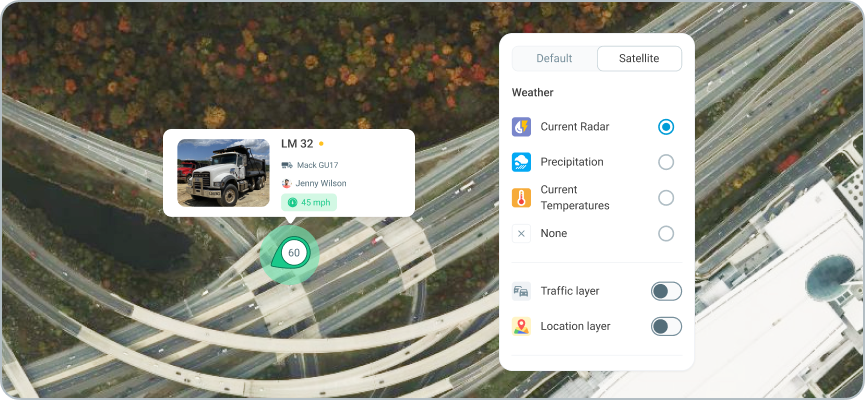
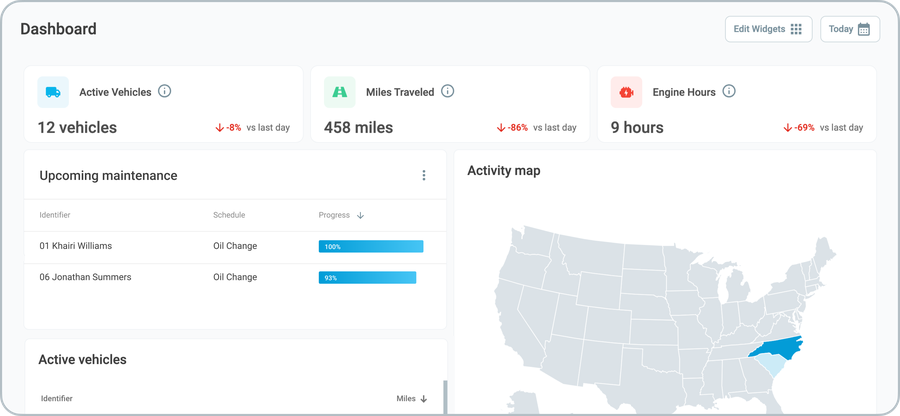
The location and engine-health layer. GPS trackers report position, speed, idle status, and direction. Modern trackers also read engine diagnostics: fuel level, battery, fault codes, engine hours.
What to look for in construction:
- Update frequency. Once a minute is acceptable for billing; every 5 seconds is the difference between "the truck is somewhere on this site" and "the truck is at this specific stop." Fleet Chaser updates every 5 seconds with 5-meter accuracy.
- Equipment compatibility. Most trackers were built for vehicles with a standard OBD-II port. Heavy equipment (excavators, dozers, skid steers) often has no CAN bus or a non-standard one. Ask about equipment compatibility specifically — Fleet Chaser supports 99% of construction equipment including Cat, Komatsu, Deere.
- Tracker hardware lifespan. 4G trackers from credible vendors last 5–8 years. Cheap units fail in 2.
2. Dispatch and route management
The day-to-day workflow layer. Where most "fleet management software" breaks for construction.
Most dispatch tools were built for over-the-road trucking — one driver, one truck, one route, one delivery. Construction reality: a 3-person crew, a pickup pulling a trailer, a job site with a load, a work stop, and a drop. Real construction dispatch needs:
- Multi-assignee tasks. A site prep with 3 crew members isn't 3 separate tasks; it's one task with 3 assignees who see the same job on their phones.
- Typed, color-coded route stops. Load, Delivery, Job Site as distinct stop types (not just "addresses in order"). Job Site stops should gate the route — the driver can't advance past until the work there is logged.
- Drafts, scheduling, and team transfer. Build the task the night before. Auto-publish to the crew on the morning of. Hand a job to a different team mid-day without re-typing it.
This is the area Fleet Chaser invested heaviest in over the last two months. If dispatch is your pain point, demo this specifically.
3. Dashcams and driver safety
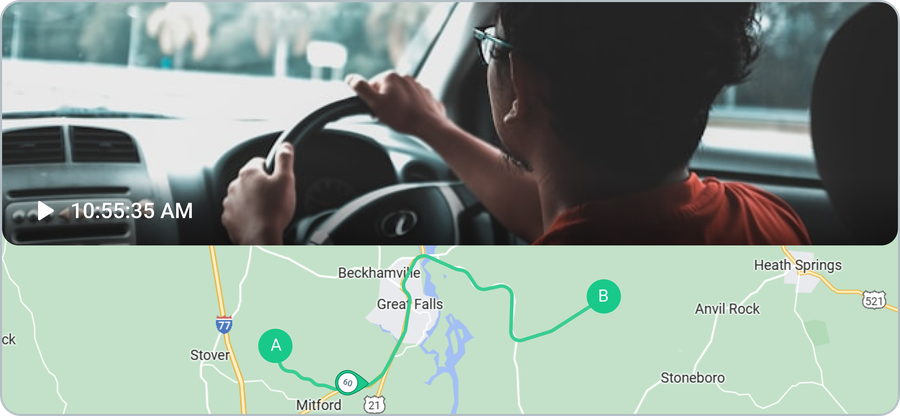
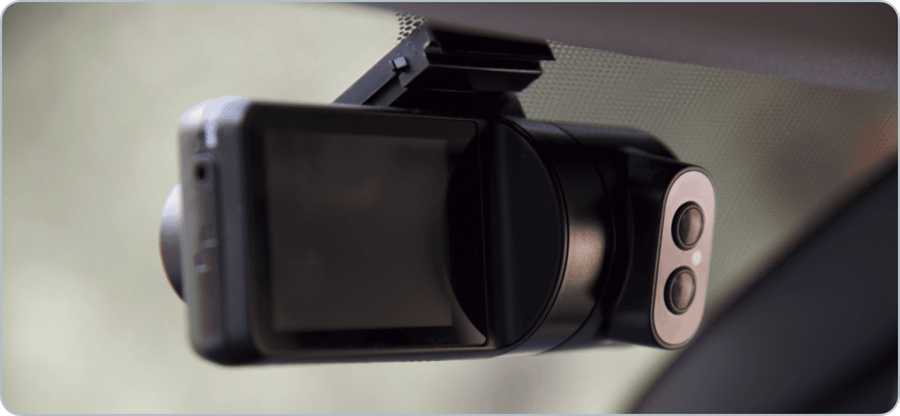
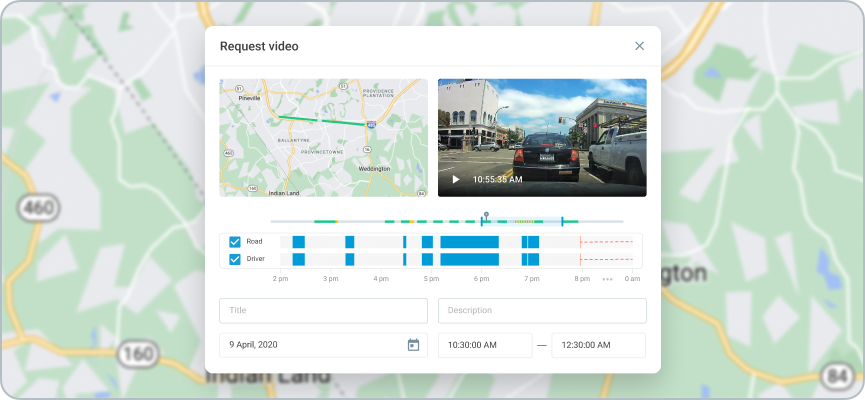
The risk-and-liability layer. Two camera angles (road plus cabin), continuous recording, event detection on hard braking and sudden lane changes.
What to look for in construction:
- Resolution that reads license plates. Anything under 720p is decorative; modern systems hit 1440p. Fleet Chaser dashcams read license plates from 100 feet.
- Truly live streaming. Not "request a clip and wait 4 hours" — actual live video on demand for emergencies. Worth asking about explicitly.
- Storage retention. 15 days is the standard floor for incident review and insurance disputes; some platforms only retain 48 hours.
- Insurance discount. Most carriers discount premiums 5–15% with documented dashcam coverage. Worth filing the paperwork.
4. Maintenance management
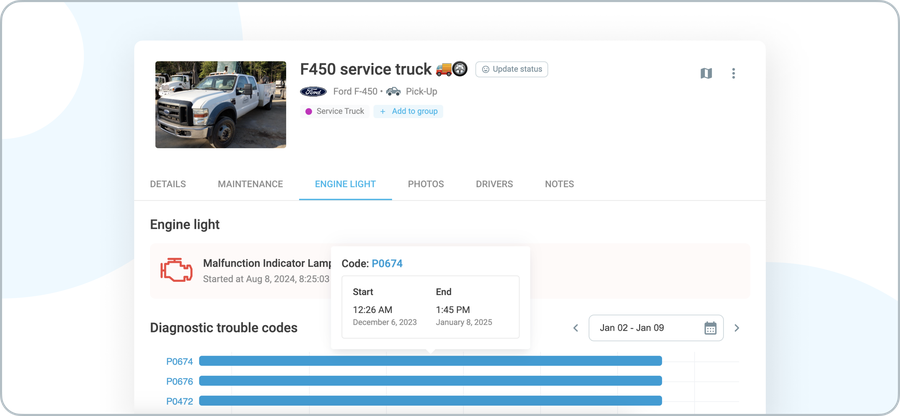
The cost-control layer. Engine fault alerts (DTCs), scheduled preventive maintenance, downtime tracking by asset.
What matters most for construction:
- PM scheduling by engine hours, not just miles. Heavy equipment maintenance is hour-based (every 250 hours, every 500 hours), not mileage-based. Trucking-focused tools handle this badly.
- Proactive fault code alerts. A DTC alert at the right time prevents a $5K repair from becoming a $25K rebuild. Most platforms can pull DTCs from OBD-II vehicles; ask about equipment.
- Downtime visibility. Which asset is down, why, and for how long — surfaced in one report, not buried in CSV exports.
Home Evolution Roofing (Albany, NY, 40+ trucks and vans) saved $60K annually on maintenance after adopting fleet management technology, with 3× faster maintenance scheduling. Their maintenance manager: "Without Fleet Chaser, we'd need a full-time person just to track maintenance manually."
GPS-only vs full fleet management
A common question: do I really need the full platform, or is GPS-only enough? The honest answer depends on where your fleet sits across four tiers:
- Basic GPS-only ($5–15 per vehicle per month). Location, basic alerts, light reporting. No dispatch, no inspections, no maintenance module. Fine only when you're not losing hours in Excel on tasks the platform should handle and you're not getting billed on disputed hours.
- SMB fleet management ($15–30 per vehicle per month). Everything above plus dispatch, geofences with billing reports, inspections, driver app, maintenance. The construction sweet spot — Fleet Chaser sits here at $20–25/vehicle/month.
- Mid-market trucking-grade ($30–50 per vehicle per month). Above plus deep ELD/HOS, driver scorecards, integrations, a dedicated CSM. Overkill unless you're a compliance-regulated trucking operation.
- Enterprise ($50+ per vehicle per month, on 1–3 year contracts). AI dashcam fleet, advanced telematics, multi-region, SLA. More than you need below 500 vehicles.
GPS-only is the right call only when you have under 10 vehicles, no equipment, no crew dispatch, and billing is straightforward. As soon as any of those flip, the cost of "saving" $10/vehicle/month on GPS-only is more than $10/vehicle/month of admin time and disputed invoices.
5 things fleet management technology actually does (with real numbers)
1. Spots maintenance issues early
DTC alerts plus scheduled PM by engine hours catch problems before they become rebuilds. Home Evolution Roofing: $60K saved annually, 3× faster maintenance scheduling, 20% faster on-site work.
2. Tracks every vehicle and every piece of equipment
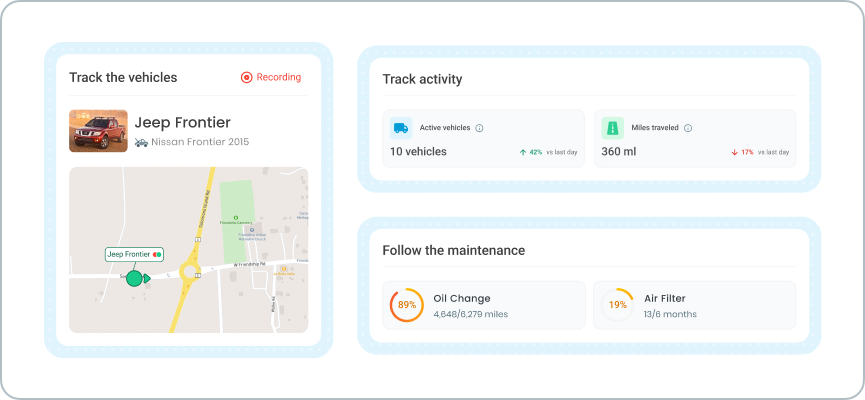
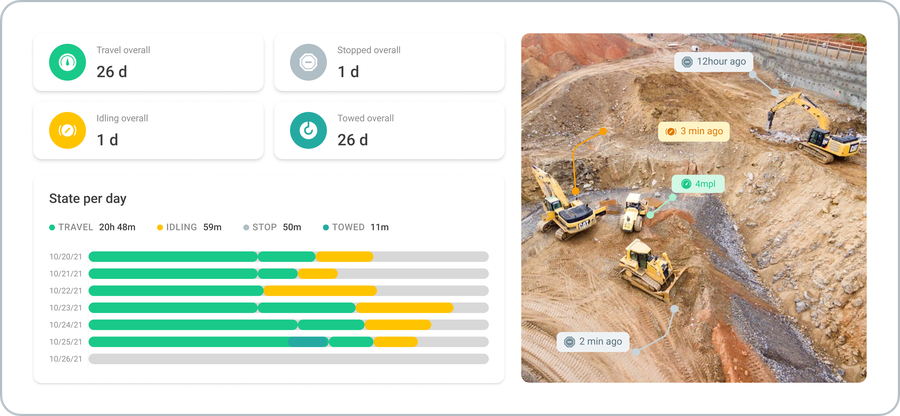
Real-time GPS plus 99% equipment compatibility means the dashboard shows your trucks AND your skid steers AND your dozers with the same metrics. No more "where's the bobcat?" Slack threads.
3. Optimizes crew dispatch and multi-stop routes
Typed Load/Delivery/Job Site checkpoints with the Job Site stops gating progress. Multi-assignee tasks so a 3-person crew sees one job, not three separate ones. Schedule the task at 6 p.m., it goes live on the crew's phones at 6 a.m.
4. Bills clients accurately with geofences
Three timestamps per job (arrival, on-site, departure) customers pay against without arguing. Plus customer-facing Live Share links — Uber-style trackable URLs that kill the "where's my truck?" calls. Landmark Materials (Monroe, NC, 30 trucks) lifted fleet efficiency 40% and cut idle time 60% on the back of this workflow.
5. Defends against fraudulent claims and unauthorized use
Dashcam footage plus GPS history plus geofence alerts. Landmark Materials saved $100K+ defeating fraudulent accident claims with GPS and dashcam evidence on every alleged incident. Five years in, the tool more than paid for itself the first time it kept them out of a settlement.
Fleet Chaser — a worked example
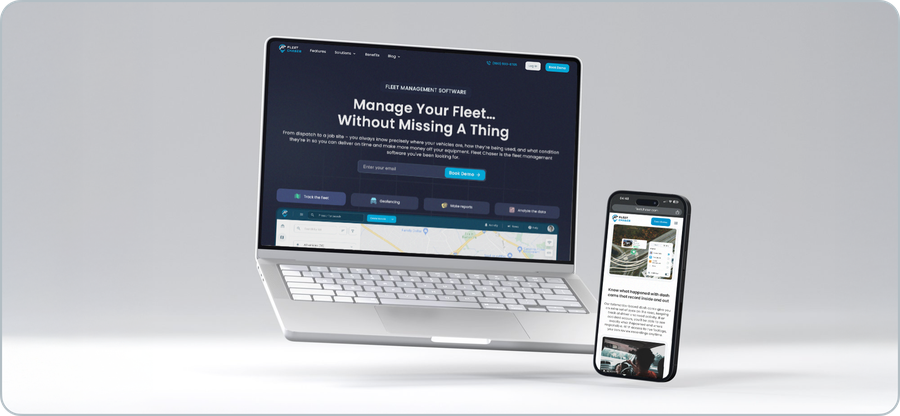
The full stack in one platform, sized for construction SMB:
- GPS every 5 seconds, 5-meter accuracy, 4G trackers with a 5–8 year lifespan.
- 99% equipment compatibility (Cat, Komatsu, Deere, plus less common brands).
- Dispatch with Tasks v2: multi-assignee, drafts, schedule automation, team transfer, progress visibility.
- Routes with typed Load / Delivery / Job Site checkpoints.
- Geofences with polygon shapes, per-customer reporting, customer-facing Live Share links.
- Inspections, time clock, notes, chat, dual dashcams (1440p, truly live streaming, 100ft plate read, 15-day storage) — all in one driver app.
- $20–25 per vehicle per month, $25+ per dashcam per month.
- Month-to-month, no contract, unlimited users (pricing by vehicle, not per seat).
Three customer outcomes across three industries:
- Home Evolution Roofing — $60K+ saved annually on maintenance, 3× faster scheduling.
- Landmark Materials — $100K+ saved defeating false claims, 60% idle reduction, 40% fleet efficiency lift.
- Lake Norman Turf — "Trackers paid for themselves in the first month from our savings."
What to do next
If you're sizing up fleet management technology for a construction fleet, the natural next read is our buyer guide: How to Choose Fleet Management Software for a Small Construction Company (2026) — the same framework applied to a vendor-by-vendor shortlist (Samsara, Fleetio, Motive, Verizon Connect, Tenna, Fleet Chaser).
If you want to see Fleet Chaser specifically on your own fleet, book a demo at fleetchaser.com. Bring your asset mix, a customer site address, and the cancellation clause from your current vendor. We'll have your fleet on the map, a geofence drawn, and a 3-stop task with a 2-person crew running on a phone before the call ends.
Updated for 2026.
How quickly can a construction fleet adopt fleet management technology?
Most SMB construction fleets are live within a week. Tracker installation takes 15–30 minutes per vehicle; equipment trackers may take longer depending on the unit. The software side is same-day — accounts, role-based dashboards, and the driver app roll out together.
Does fleet management technology replace my IFTA, accounting, or billing software?
Not entirely. It generates the data your IFTA, accounting, and billing systems need (mileage by jurisdiction, time-on-site by customer, fuel by vehicle) and exports cleanly to them. Most construction fleets pair fleet management with QuickBooks or Sage rather than replace them.
What's the realistic monthly cost for a 25-vehicle construction fleet?
At Fleet Chaser's $20–25 per vehicle per month, a 25-vehicle account is $500–625/month before dashcams. Add $25+ per camera per month for dashcam coverage. No contract minimum, unlimited users. All-in for a 25-vehicle fleet with full dashcam coverage: roughly $1,100–1,250/month — versus enterprise platforms whose "starting at" prices resolve to $35–45 per vehicle on 3-year contracts for the same account.
Can fleet management technology track heavy equipment (excavators, skid steers, dozers)?
Yes, if the platform was built to — most weren't. Construction-aware platforms like Fleet Chaser support 99% equipment compatibility (Cat, Komatsu, Deere, plus the long tail) with engine hours, location, and DTCs tracked the same way truck miles and engine codes are. Generic fleet platforms often need a separate tool for equipment — two invoices, two logins, no shared reporting.
Is there a contract? What if it doesn't work out?
Fleet Chaser is month-to-month, no contract minimum, cancel any time. Most enterprise platforms lock you into 1–3 year contracts with annual prepay; the "starting at" prices you see in marketing assume that lock-in. Watch the cancellation clause closely on any vendor — month-9 regret is real.
Does fleet management technology work for construction-adjacent industries?
Yes. Roofing, landscaping, waste management, regional logistics, and field service (HVAC, plumbing, electrical) share the same mixed-asset, multi-stop, crew-dispatch reality as construction. Fleet Chaser's customer base spans all of these — Home Evolution (roofing), Landmark Materials (construction materials), Lake Norman Turf (landscaping), Value Waste (waste hauling).